
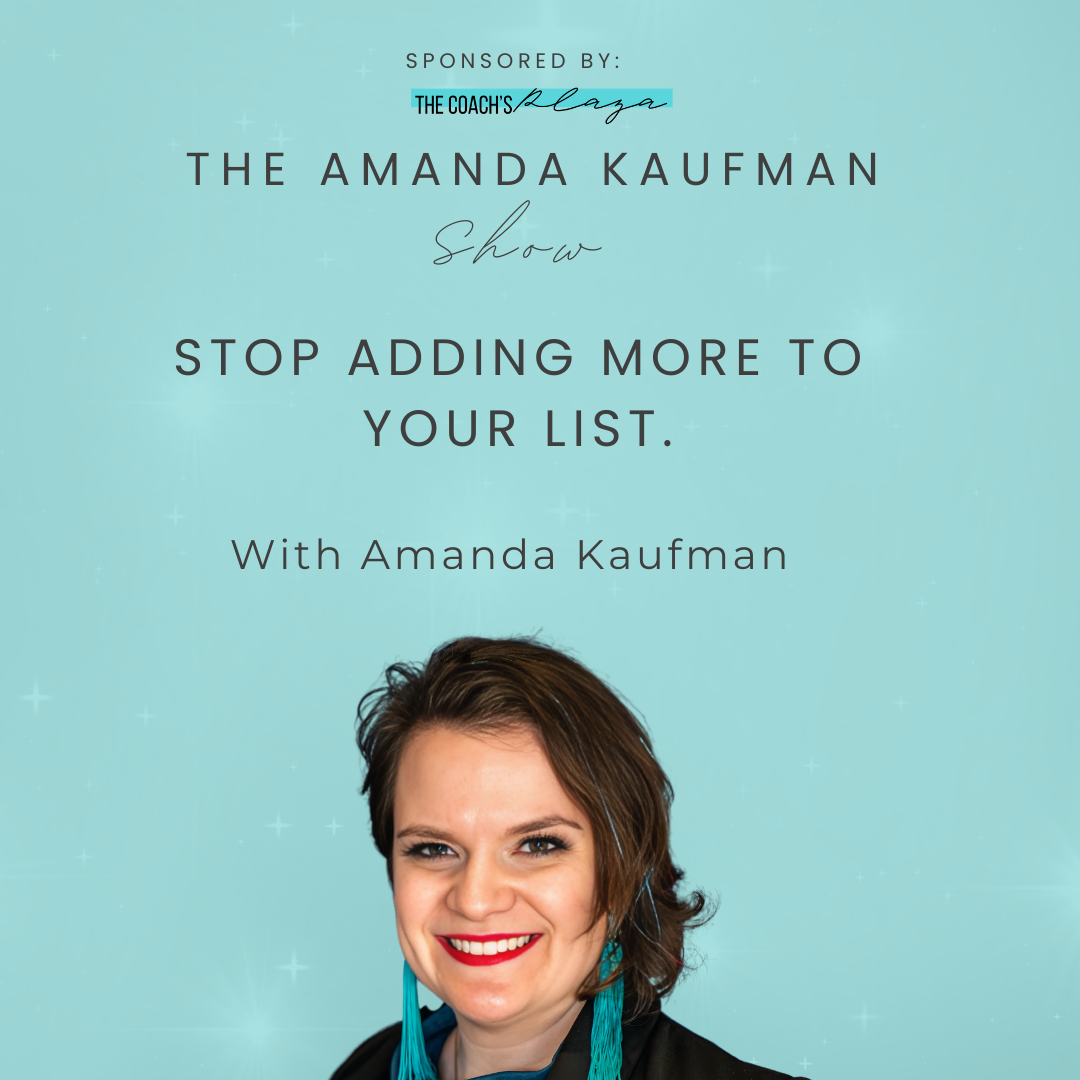
Stop Adding More to Your List. The Order You Do Things Is Making or Breaking Your Business
Stop Adding More to Your List. The Order You Do Things Is Making or Breaking Your Business
You Don’t Have a Work Ethic Problem
If you feel like you’re constantly working but not seeing the results match the effort, it’s not because you’re lazy or inconsistent.
Most people I talk to are doing a lot.
They’re posting, tweaking offers, learning new strategies, trying to stay visible, and keeping themselves busy throughout the week. And yet, when they step back and look at the results, it doesn’t feel proportional.
That disconnect usually leads to the same conclusion: “I must need to do more.”
So they add.
And that’s where things start to get heavier instead of better.
The Real Problem Is the Order
The issue isn’t how much you’re doing. It’s the order you’re doing it in.
You can take all the right actions and still feel stuck if they’re happening out of sequence. When that happens, your effort doesn’t build on itself. It just spreads out.
This is how people end up with a business that feels chaotic. A bit of content here, a bit of outreach there, maybe some backend work, maybe a new idea they’re trying to test… but nothing is really connected.
It looks like progress from the outside.
It doesn’t feel like progress on the inside.
Your Business Is Not a To-Do List
One of the biggest mindset shifts is realizing that your business is not a list of tasks to complete.
It’s a system.
And systems only work when the steps are in the right order.
If you treat your business like a checklist, you’ll default to whatever feels easiest or most familiar that day. That might mean organizing, planning, consuming content, or tweaking things that don’t actually move the needle.
The problem is, those tasks feel productive.
But they don’t create growth.
What Actually Moves Things Forward
At the core, growth in a coaching or service-based business comes down to a simple flow.
You connect with people.
You understand what they’re dealing with.
You have conversations.
And those conversations turn into clients.
Everything else should support that.
When that sequence is clear, it becomes much easier to evaluate what matters and what doesn’t. If something you’re doing isn’t leading to more conversations or better conversations, it’s worth questioning.
That doesn’t mean it’s useless. It just means it might be out of place.
Why Tracking Changes the Game
Another place where things break down is a lack of tracking.
Without tracking, you’re relying on how things feel. And feelings are unreliable when it comes to business decisions.
You might feel like something isn’t working, but you don’t actually know. Or you might think you’re doing enough, but the numbers tell a different story.
Tracking gives you something objective to work with.
It shows you where things are actually breaking down. Not where you think they are, but where they are.
And once you can see that clearly, you can make adjustments that actually matter.
Where Most People Get Stuck
Even when people start tracking, they don’t always change anything.
They collect data, but they don’t act on it.
This is where the emotional side of business shows up. It’s easier to tweak something you’re already comfortable with than it is to address the real gap.
So instead of fixing what’s actually slowing things down, people keep adjusting the parts they understand.
And nothing really changes.
Why Willpower Isn’t Enough
A lot of people try to fix all of this by pushing themselves harder.
More discipline. More focus. More effort.
But willpower is limited.
You can’t rely on feeling motivated every day, especially if you have a lot going on outside of your business. Life will always pull on your attention and energy.
If your business only works when you feel “on,” it’s going to feel inconsistent.
That’s why systems matter.
Systems Remove Friction
When you build systems, you stop deciding from scratch every day.
You already know what needs to happen, when it needs to happen, and how it connects to the bigger picture.
That removes a lot of the mental load.
Instead of asking “what should I do today?” you’re executing something that’s already been thought through.
That consistency is what allows things to compound.
You Will Hit a Limit on Your Own
At some point, even with good systems, you become the bottleneck.
There are only so many hours in the day, and only so much you can hold mentally.
This is where support comes in.
It might be tools, automation, or a team. It might be getting help with execution so you can stay focused on the parts of the business that actually require you.
The goal is not to do everything.
The goal is to make sure everything that needs to happen… happens.
Bringing It Back to Sequence
When you zoom out, everything comes back to order.
Taking action matters, but only if it’s the right action at the right time. Tracking matters, but only if you use it to make decisions. Systems matter, but only if they’re built around what actually drives growth.
If those pieces are out of order, things feel harder than they need to be.
If they’re aligned, things start to feel simpler.
Not easy, but clear.
The Shift to Make This Week
If you take anything from this, let it be this.
You don’t need to add more.
You need to look at what you’re already doing and ask whether it’s in the right order.
Because in most cases, the gap isn’t effort.
It’s sequence.
And once that clicks, the same amount of work starts producing very different results.
Chapter List:
00:00 Why Working Harder Isn’t the Problem
01:10 The Real Reason Coaches Struggle
04:30 You’re Doing Things in the Wrong Order
06:00 Why Order Matters More Than Effort
09:30 The “Frankenbusiness” Trap
13:30 Stop Adding More to Your Plate
15:00 The 4 Modes of Business Growth
18:00 The Real Client-Building Sequence
28:00 The Two-Step Sales Process
37:30 The GPS Analogy That Changes Everything
Full Transcript:
Amanda Kaufman (00:00)
The order that you do things is making or breaking your business. And the big elephant in the room, friend, is that you are meant to be successful as long as you're willing to do what is necessary to be successful,
All right, all right. Welcome to a strong start. Today we are talking about how to do less so you get more in your business. And I'm really excited about this topic because I got to tell you, so many people who are helpers and they are heart led entrepreneurs, they just want to help people. They struggle with actually doing it.
Actually helping people like in a really really meaningful way. So if you can see me and hear me Let me know in the chat. I'm super excited that you're here and we're gonna get this party on the road, so If you're looking for the full replay, by the way, make sure you join us inside of our group That's next number five clients comm that's next number five clients comm and
We're we have all of the replays of every single one of my strong start lives Even from before I started calling it the strong start. So there you go. I want to really address a big Elephant in the room, which is that a lot of people who are building an expert-based business whether you're a coach or a consultant a mentor a trainer
However you label that, you're using your genius to create great outcomes for other people. Right, fair? And by the way, let me know your genius in the chat because I want to celebrate you owning that. That's really, really awesome. But the big elephant in the room is that not very many service-based business owners that are using their expertise are actually successful. And I just want to put it out there, this has nothing.
And I mean no thing to do with your intelligence. It has nothing to do with your aesthetics. It doesn't have anything to do with your, you know, people say it's like, you are the average of the five people that you hang out with. It's actually not your family's or friends fault that you, that it's so hard. We have to remember that when we are putting ourselves out there as a genius in a particular given area.
And even if we're just like being really modest about it and was like, well, I'm not a genius. I just want to help people. The rough, tough truth of it is, is that most people are unsuccessful with this kind of business. And I'm now in year nine, to give you context. Statistically, very challenging to say those words. I'm here in year nine, doing this full time. I left a corporate job to be able to do this.
And I really want to deal with this elephant in the room, you know, where people don't feel like they can be successful. They don't feel like they can build a business that gives them the freedom that they want to have. They don't feel like they get respect. They don't feel like people appreciate them and appreciate their genius. Today, we're going to address one of the biggest areas that slow us down. So I had a long, long title for today.
Stop adding more to your list. The order that you do things is making or breaking your business. And the big elephant in the room, friend, is that you are meant to be successful as long as you're willing to do what is necessary to be successful, right?
So, girl, you left me a comment anyway to say you're multitasking.
good Tonya, I'm glad you're here. Okay, so let's talk about this. It took me so long to figure out that in my business, I was not failing because I wasn't working hard enough. even this past week, I was working with a mentor and she stopped me mid-sentence and she said, you're rationalizing how hard you work.
I was like, excuse me. Of course she was right. But I think when you work really hard, it's very easy to get into the narrative that like I should be further along by now because I work so hard. And it took me an embarrassing amount of time to to learn what I'm telling you now. And like, let's let this be my catharsis of of telling you this. But also, I really sincerely hope that what I'm going to share with you today is going to
shift something for you, that you get to feel more peace as you grow, that you get to have more impact with people, that you can have a stronger executive presence with people, that your expert positioning is gonna be legit and not desperate, like this is fire. the rough and tough truth of the early years of my business is that it wasn't that I wasn't doing enough.
it was that I was doing things in the wrong order, right? Write down in your notes, order, right? And even if you're multitasking, pause and just be like, order, right? Order. So I had a full to-do list. I was checking things off. I was staying incredibly busy, but my business wasn't moving. I wasn't enrolling new clients. I wasn't getting new opportunities. It was stuck and stagnant. And...
The reason for that stuckness was so simple, it actually made me angry when I figured it out. So the thing is, that your success comes from the sequence of steps you do, not that you can outwork everyone. It comes from the sequence of steps that you do, not that you outwork everyone. And the order matters so much more than just the number of things that you do. So like,
I cannot tell you how many entrepreneurs, how many like legit heart led, actually very smart, intelligent, hardworking humans I have talked to when they have a tear in their eye because they're working hard. They're trying hard and they want to give up because it feels like the try is never going to pay off. And so today I'm going to show you exactly what sequence matters in a coaching business because
when I had things out of sequence and when I see this with all the people that I talk to nowadays, they're working on the right thing at the wrong time. Right? So let me give you some examples just so that you're really, really clear about where this could be showing up for you. They are working to optimize a webinar, but they haven't figured out traffic yet. So if that's like all gobbledygook, what I mean is,
You can work on the best speech in the world, but if you don't know how to get an audience to listen to that speech, what are you doing? Honestly, what are you doing? Right? It's the wrong order. Another good example of this is when people are hiring, they tend to hire for things that they are scared of or they find really annoying or something like that, which in and of itself isn't terrible. But where it shows up in the sequence is like,
if you're hiring salespeople and you don't have an abundance of lead opportunity that's warmed up through marketing to make those salespeople successful. So I see this at every level of business. This is not just for beginners, but I've noticed especially among the beginners, know, the not beginners. So what I mean by not beginner is like somebody who's probably taken one or two or three or four or 10,
Marketing courses you've done all the webinars you've bought the programs you've watched the courses you understand The pieces and parts of your business so like you took the email marketing class or you took the webinar class or you took how to master YouTube or you took You know how to slay at Instagram you had like all these different pieces But you can still be unsuccessful why?
The reason why is because it's a Frankenbusiness. You've got this Frankenstein of all the little bits and bobs and parts of your business, but is it a cohesive experience? Is it a consistent and congruent experience for both you as the operator of the business, but even more importantly, from the perspective of those that are moving through your ecosystem that you're building. And I see this even with six-figure entrepreneurs and multi-six-figure entrepreneurs.
They have parts of the business that work and that's why the business exists. But they're stuck at their ceiling of revenue because they keep throwing resources, time, money and energy at things that don't help the business grow. They're doing the right things but because they don't have the foundation in place, they're doing the right thing in the wrong order. So that's one of the biggest things that I want you to know. Most coaches, they treat their...
business like it's just this big to-do list. And if you're like me in the home, like I'm a mom, I've got several kids and a couple cats and a Chris, you know. So there's a lot of things about running the home that I do treat like a checklist. It's like, okay, you know, get people fed, pick up the groceries, maybe tidy something sometimes, right? Occasionally do laundry. That's just like a checklist. And if you just do those simple things, then your house won't burn down, right? And it won't be chaos and it won't breed disease.
But like your business, it requires a different level of sophistication. I think the thing too is like, if you are left to your own devices and you've got like just this pile of to-dos, these pile of tasks, which is like, I'm telling you 98 % of coaches that I talk to, this is their reality. First of all, they barely have everything, like they don't have a system for organizing all the stuff. And even if they have a...
Assistant for organizing all the tasks or listing all the tasks or capturing all like they don't have a consistent way that they capture prioritize Sequence and schedule their tasks. And so what ends up happening? Well, it's overwhelming It's so overwhelming. It's like oh, I've got to reach out to this person. I got follow-up on that I want to build that curriculum. I want to set up that technology. I want to post a social media post a social media a million times a day I want to I want to
reach out to that speaking opportunity. I got to write a book. I got to be a speaker. I got to be somebody other than who I am. God, when is it going to get better? And the answer is when we slow down. So when we slow down, I always think like, if my hair is on fire, stop, drop and roll. And I tell all my clients this whenever you're just completely overwhelmed by the bills coming due, the tasks on your plate.
the skills to build, just all the stuff. It's like, I literally call it Les Paws. You need to build in Les Paws, right? Because when you're in this reactive, I gotta crush this to-do list, AKA the to-do list is crushing me kind of place, you're probably gonna pick the thing that's the most comfortable thing to do, right? The easiest of wins, the low hanging fruit. And that's logical to an extent, but it won't build a business.
It won't build a business. It'll feed your dopamine. It'll feed your sense of progress. And if you're ADHD like me, you know, like that, there's some value in that, right? Because momentum begets momentum, right? Sometimes like doing the easy obvious thing can give me just a little bit of a nudge that I need to be able to do the big thing. But if the big thing never makes it onto the calendar, if the big thing never makes it into priority, guess what never happens? The big thing. And so our...
We're talking today about like the action pillar of the let's launch formula. And I don't care if you already have a multi six figure business or even a seven figure business that's not working very well. You know who you are. Right. Like if you've got profit just leaking and you have like horrible expenses and yes, you're making money, but you're losing it every single month.
Like listen up because this let's launch formula is not just for beginners, although it's great for beginners too because you're gonna start super strong, right? Shout out strong in the chat if you hear what I'm saying. So here's the reason that we have to get the sequence right on your actions, right? It might not be the right time to do your webinar. It might not be the right time to become an Insta Famous guru. It might not be the time to launch your podcast. Here's what...
I would suggest that you do is the first thing is really just understand that the to-do list isn't the problem. It's the order that you're doing things. So because you keep hacking at the easy low hanging fruit on the bottom of the list, whether it's doing laundry or the dishes, instead of sitting down and working out what your strategy is going to be.
Honestly, one of the top pieces of advice that I got from a female entrepreneur really early on was hire somebody for the housekeeping, right? And then when it became apparent that my husband preferred not to pursue his business interests, I'm like, well, you can do whatever you want. And we also have a home to run.
which he gladly stepped into, by the way. He gladly stepped into that. But if you're in a dynamic or in a family or if you're single and you don't have a Chris, which most people don't have a Chris, you can hire somebody to handle some of the load and like start with a couple of hours of, you know, every couple of weeks. You'd be so surprised and like take a look at what you're spending in your discretionary spend.
You can probably find it in your Starbucks budget. You could probably find it in your going out budget. You could probably cancel a few streaming services. Like you can find the budget to have somebody do the parts of the housework that never gets done and makes you feel miserable or just like keeps you from feeling so distracted all the time. So I really want to encourage you to support another business in that way. So. I think the other piece is like.
average coaches tend to just add to their list when things aren't working. Who's guilty of that one, right? I am, right? Shout out I am in the chat. If you've ever gotten frustrated that things weren't moving, so you just turn around and you added something else to their list and you just sort of assume that more volume was going to fix it. That if you just worked harder that it was going to work out. And the coaches who scale tend to ask like what comes first and then they do it completely. So in my programs I teach
One until done, one focus until finished. And then you let that sequence create the momentum that your effort alone never could. So when I'm building my business, there's basically three modes that I, well, four modes that I operate in my business, okay? There's the deciding stage, which is where I'm selecting strategy. There's the designing stage where I...
picked my strategy and now I'm going to design what I'm gonna do next to do it. There's delegating, so this is where I pause and I say, hey, am I the best person to do this with the resources and time that I have? And in different seasons, sometimes it's like, girl, there's really not too many people else. As I've gotten more mature in business, I've also gotten more mature in my network and in connection and I found that there's a lot of people who are willing to help.
to gain experience, be able to grow their own skills and their own opportunities. So like a lot of what you design that needs to be done, you do not personally have to be the one to learn how to do it. The fourth thing is of course the doing. So in a coaching business, 80 % of the doing is actually this, it's coaching and content creation. Right, it's content creation because some people are not going to...
be ready to step into the next level with you. But it's also content creation because the people who have stepped in with you want to stay in touch. And it's also content creation for, of course, the new people that are coming along to get to know you to then decide if they're going to work with you. And then also, it's content creation for people who are never going to buy from you. Right? They like you. They support you. They'll share your information. They'll share that you exist in the world. But that's the extent of the relationship. And that is okie dokie cool. Right? So 80 %
of the time should be spent in the actual fulfillment of the business. And as the business grows, this is what's really crazy. As the business grows, you're gonna start to be able to hire out pieces of the business. So then you are no longer in the doing hours. So as your business grows bigger and bigger, you're spending more and more time in decision making, personally, because there's time that other team members in AI are taking care of.
that you no longer have to do. Right? So if you're just drowning in the to-do list, it's because of the sequence. The real sequence for building a coaching business is not build a fabulous program. It's not shoot a bunch of videos. It's not build something super polished. Nope. It's actually backwards. So it's meeting people, talking to people, fitting with people, and fulfilling with people.
And here's the big secret that nobody tells you or maybe you've heard it you didn't believe it. I'm here to tell you it's true. The real truth is that there's a lot of things that you can create that no one ever wants to buy. And when I say there's a lot, I mean 99 % of your ideas are probably not marketable. And that's just being real and being true. And this breaks a lot of coachy hearts because they're like, but...
It would have been so good if I had this unique, perfect product on my journey. And so I want to build it for this other unicorn person who is uniquely me. And I want it to be exactly like the thing that they need. And here's why that does not work. Think about who you were at that time that you were experiencing a bunch of pain. Did you look for a product like the one you're building?
If the answer is no, you personally did not look for a product like that, what are you doing? What are you doing? And that was a huge breakthrough for me is like, I used to try to build and cultivate things that looked perfect and polished and thought through and well-researched and all of that good stuff. And I wanted to step out into the world with a product that was already super shiny. And what I realized is that a minimally viable product
is so much better because people will pay for what people want to pay for. You might write that down. People will pay for what people want to pay for. It's the 1 % idea out of everything that you could do that they're like, I want that. I want that. So instead of spending all your energy trying to build like this unicorn product that no one's ever seen before and therefore won't recognize and therefore is going to be very, very difficult to sell, instead,
Make a point of connecting with new people, meeting people, talking with them. And here's the conversation. I hope this is not too nerdy on a Monday, but I'm telling you, like, this is the actual shortcut to an expert-based business. When you talk to people, don't tell them anything. I mean, if they ask, you can tell them. But your mission when you're talking to people is not to tell. So an example of telling.
I am a coach of coaches. I am a financial coach. I am a relationship coach. Because the second you say that, people start going, shit, now she's going to sell to me, right? Which it turns on this like buyer beware brain. Instead of telling people everything that you're doing, your first move is actually to ask, right? Shout out ask in the chat. So what are some things that you ask?
You ask what brings you to this event. You ask what are you working on? You ask what are you all about? You ask what's a goal you're working towards right now? You ask who would be somebody you'd love to be introduced to? Here's what you're going to hear. You're going to hear what business they're in if they're an entrepreneur. You're going to hear what career they're in if they're a professional. You're going to hear what their values are. You're going to hear what their objectives are.
You're gonna hear what's important to them. You might even hear what their obstacles are, what their challenges are, what they might be afraid to say out loud. And you'll be able to hear all of this stuff. So then you, the entrepreneur, you are listening for the problems of appropriate magnitude. That's what we call it in our first five club. By the way, if you wanna be in the club, good idea, because tomorrow we're gonna be doing a live interactive coaching session.
shout out club in the chat or send me a DM at the Amanda Kaufman if you want to get a pass to come to the club. The club is my most accessible coaching program. It's bomb diggity and we'd love to have you inside, but just send me the word club if you're interested in details about it. Okay, so you are asking, not telling. And when you leave the event, you're
reflecting on what is it that people are doing? What is it that they're working on? And how could I help? And as you get really good at this, you start to hear, my God, I could totally help with that. Now again, we're not telling, we're not saying like, my God, I could totally help you with that, right? Because we're switching on buying brain. And the time to buy is in a consult, not in a connecting conversation.
However, the fact you're having the connecting conversation increases the likelihood they'd be open to a consult conversation down the road. So if you're hearing all these signals of like, my God, I could totally help with that. The next thing is to ask them like, are you open to receive? Are you open to a question? And if they say, no, I'm good, then you know that they're not really interested in getting support or help. But if you say, yeah, if they say, yeah,
then you can now tell them, right, I actually work with people like this. I've helped a lot of people with this exact obstacle or if that's true, if it's not been true, don't lie. You can also say, you know, I've done a lot of research on this or I've been trained in this and here's what I'm hearing. Did I get that right? So the first thing that you're saying is not like, let me tell you what to do. This is what most coaches do and I'm just like jaw drop, right?
No one wants to be told what to do. No one wants to be told what to do. And people love knowing what to do. So how do we get that across? Well, we get that across like in content. The way I get it through in content is I simply talk to you as if you were already in my coaching program. Like as if you've already like enrolled.
And you know, it's lower access obviously being in content. I'm not gonna answer really long questions in content But like in in-person connection the way I do it is I'll ask like are you open to receive? you open to an idea and I'll preface that where this idea is coming from, right? I've done a lot of research in this area and it seems like and I name and label their situation and confirm my understanding Here's what can happen here
They could be like, no, you totally don't get it. Let me help you understand more better. And if that's the case, like amazing, cause they're leaning in and they want me to understand. And I love that because I do want to understand. And then, but what they often say is like, yeah, you got it, nailed it, right? And then you can say something like, I have an idea. I have an idea. And they go, really an idea? Okay, cool.
Yeah, so instead of dropping the idea right there in the networking room or right there in the DMs, you say, have an idea and it would take a couple of minutes to explain. I'm wondering if you'd be open to a call maybe after today, right? Or later this week or tomorrow or something like that. And the whole goal is to get into a specific conversation with the person to solve the problem or at least share an impression that you're getting, right? And
If you have an idea, it probably takes a couple of minutes to explain, which breaks the flow of natural conversation. So I don't solve problems in DMs. I don't solve the problem right there in the networking group. Right? Aha, if you're like, what? I thought I was supposed to walk around just being a super expert on everything all the time so that people would be so impressed with me that they throw credit card at my face. No one wants that. You don't want that.
You don't want someone to hire you not understanding their problem, not understanding your solution, not understanding how you work together, not really respecting your process because if that happens and I've had this experience, then people tend to want you to change after the transaction. So like they'll be like, well, I already paid you. So I want you to show up on my schedule on my terms in my way.
And the thing is, is if you do that for every single client that you ever have, you have just gotten yourself into a situation where you are working multiple jobs because your client is dictating the entire process, just like your boss would. So instead we flip it and we say, I'm a service provider and I have a standardized service and a standard approach that I take people through. So instead of solving the problem way upfront in the relationship,
We invite them into a conversation where we get to position as like, okay, so here's what I'm understanding of your situation. And then, you know, what do you think about that? Okay, cool. Tell me what you've already tried. And they will tell you that. And you need to know that because if you don't know that, you're going to recommend something they've already done and then the value is less. But because they told you what they're already doing, now you can add your value and have it be, wait for it, valuable.
Right? That's how you do it. And when it's been valuable, you can check in like, could something like that work? Do you think that would help you? Right? Now that you've helped, you can say on the call, again, not in chat, not in the networking event, I actually help people to do this. Would you be open to hearing how this would work if you were interested in exploring more? Yes. Awesome.
I have a 30 minute consult or I have a 60 minute discovery call, whatever your process is. So what we teach in the experts network is a two step sales process. The first call is the short one that we just did where they get value and you're assessing whether you'd like to work with them and they're doing the same thing. It's really cool. And then if they would like to consider it, it's not they want to work with you. It's they would like to consider the possibility. Then you invite them to a deeper conversation. If this is tracking and making sense, shadow why in the chat.
If you have two friends who would really benefit from this training, I want you to note it so you can text them the URL next number five clients.com next number five clients.com so they can come back to this video and watch it. Okay. All right. So the sequence is meeting people, talking to people the correct way. What we just talked about in a lot of detail is how to pull them into the fit conversation. T F
C, C being the coaching, okay? The third thing to really get is your next level in your business is not from doing huge things, it's gonna be from giving yourself permission to do the small stuff.
Small, not big. So it's so funny because my sister, I was just catching up with her yesterday. If you don't know my sister, Rebecca, she used to work with me and like we're super close anyway. So she she was just telling me she was revisiting the book Atomic Habits by James Clear. And it's so funny because I came into the office today and what did I find? I found my book Atomic Habits by James Clear. And it was such a great reminder. I asked her, said, Rebecca, what what is your favorite takeaway from the book or, you know, as you've revisited it?
And she said, I want to have a tidy apartment. So I started telling myself, I am someone who puts things away the first time. I'm someone who puts things away the first time. And she started repeating this as an identity statement. I am someone who, I am someone who. So in the context of building your business, I am someone who follows up. That's one of my little things.
It's not the big crazy moves. mean, big crazy moves are great, but I if every day, if every Monday, if every strong start, I was like, here's your big crazy move, you're going to be like, you'll tune me out right away. Cause it's just too much to absorb all at once to always have a big crazy move. Your real success is in the compounding of these small things that you do. So it could be a consistency around posting. It's the consistent habit that matters the most. And then after that,
It's making the tiny tweaks to your messaging and your approach within that. But again, getting back to the order of things, like people don't necessarily prioritize the order, right? Yeah, design your environment for success. I am someone who tells all my secrets on the internet for free, right? Like that's one of my little things that I do. And it helps me so much because you guys, I don't have to think about my content so hard because I'm literally not holding back.
How many of you have met a coach or somebody who is like, ooh, you know, I don't want to give away the farm. And if I give away the farm, then I'm never going to have a business. I'm laughing out loud because literally everything is available on the internet. And now we've got aggregators, right? We've got chat GPT, we've got Claude, we've got whatever your favorite AI tool is. And so your value, my friend, is not in regurgitation.
Let that land for a sec. The reason that so many coaches and experts are just basically driving themselves out of business practically is because they've overwhelmed their to-do list with so many things. And the thing is, is it's the little small stuff with consistency and a bit of courage, a bit of bravery as you do stuff. So for an example,
It's a bit of courage and a bit of bravery and it probably feels really big in your head, but but tactically practically It's tiny is doing the follow-up It's sending the DM It's it's it's saying hey I have an idea to somebody who has a stage or an opportunity to speak and it's this willingness to say It's okay if they deny it's okay if they reject it's okay if it's not a good fit. It's okay if the timing's not now like
That feels big for most of us, especially if you're coming from a heart centered place and maybe you're a little people-pleasy and you're a recovering people pleaser, right? The thing is, is I saw something the other day and I'm like, oh, so true. You know what sucks about people pleasing? Is no one's pleased by the behavior, right? So if you're one of those people that just doesn't assert yourself and you don't ask for what you want and you're not clear about your motives and you're not clear about your goals,
people actually shrink from that because they're like, this is shifty. This is shady. Like this is, you know, I want somebody with a backbone and that doesn't mean they have to like bowl me over necessarily, but I just want to know they have an opinion. I just want to know that they have conviction. I just want to know that they have some strength. And the thing is coach, when people are hiring you, they're not hiring you because you're nice. You can't nice your way into a six or seven figure company. And that's
Again, not tacit permission to be an a-hole, but it does mean that we have to be very clear about how we assert. And that's why this overwhelmed question is such an important one to discuss today, is because your overwhelm is making you act insecure. And it's making you act overwhelmed. And it's making you act like you're not capable. And here's the real truth. You are. You are. You are very capable.
The question is, are you willing to have lay paws and slow down and put the foundations in place that you scale from? Are you willing to let go of get rich quick? Are you willing to embrace that you will need to elevate the conversations that you have with people? If you're willing to elevate the conversations that you're willing to have with people, you will earn more.
respect and when you earn more respect you earn more opportunities and when you have more opportunities yes you do get to make more money and it is a scalable concept right because you keep building on your reputation you keep building on the respect but it requires asserting yourself and saying yes i will focus on this first no i will not focus on that and that's like the honestly one of
the toughest little tweaks here, but in the Let's Launch formula, we talked in prior episodes, which I invite you to go and check out, of course, at nextnumberfiveclients.com. They're completely free. We talked about the Let's Launch formula having the action it, track it, believe it, and drive it, right? So this has been all about action. You already take action. The question is,
Is that action reinforcing and compounding towards your goals? Or is that action reinforcing and compounding towards missing your goals? So a really easy example in 2026 is rabbit holes. Are you falling down social media rabbit holes? Are you falling down AI rabbit holes where you are in a conversation that's stimulating but not necessarily progress making, right?
Those are really powerful questions because you're in action. You're doing something with all 168 hours you have every single week. The question is, what are you doing? And if you're doing things other than meeting people, connecting and talking with them, inviting people into fit conversations with you so that you can coach. Well, can we really feel like it's a big mystery why our field struggles to attract business, right?
the sequence, it's the order. So I want you to think of this kind of like a GPS, right? Let's say you're going on a road trip and the destination is a six-figure thriving stable coaching business and you are where you are. The reason we tend to do things out of order is because we want to believe that we're on a different, we're in a different location. So like let's say I wanted to go on a drive to New York and I
I thought of myself as being in LA, but I'm actually in Fort Worth, Texas. If I say New York destination starting from LA, then that's not going to help me in Dallas, right? That's not going to help me in Fort Worth. So if I really want to go where I want to go, I need to first get really real about, I have fundamentals here? Fundamentally, am I meeting people? Am I leaving my house?
Or am I leaving my zone of comfort and am I seeking to connect with people who I hope to someday serve? Because if I'm not doing that, if I'm not even looking at them as human beings that I want to be in relationship with, what are we even talking about?
What are we even talking about, right? If we're talking about building a fancy program that has a great reputation and everything, well, have you helped one person? Have you helped five people? Now, sometimes people get to this place where they sort of hit a ceiling because they found that they help people really well in person and they think, or privately, and they think, well, I cannot build a group.
your successes in the sequence. So have the people who have worked with you gotten great results? If so, what was in common? Build a program that hits those notes. And will it be this reputation building awesome group experience on the first day of school? Maybe, more likely, you're going to have made some mistakes. And that's not because...
You didn't mean well, it's not because you're not smart. It's not because you didn't invest the time, the energy, the money. It's because no plan survives contact with reality, right? So you're going to experience a reality of like, people behave a little differently in a group program than they would in a private program. What a lot of people do is they'll be like, well, I'm just like stuck in my thinking that I got to stay a private coach. But then what ends up happening,
is their calendar is so maxed out all the time, they don't get that next level of freedom that they're really after. So whatever obstacle you have to growth, whether it's I need to go out and meet people or maybe you've already met lots of people, you've filled up your private practice and now it's time to do the group, either way, your success is in the sequence. So instead of thinking it has to be a perfect group program with huge reputation, start with the beta. Start with testing how it's supposed to work.
And it all takes courage. But the reason that most people don't do it is because they'd rather be already at arrival. So they're working on arrival things. They're pretending like they're in New Jersey going to New York. And the thing is, like, you're in Dallas and you're going to New York, you got to admit that you're in Dallas first so that you can actually do the things that are necessary to get to New York. You know what I'm saying? OK, cool. So just keep thinking about that GPS metaphor. I'm telling you, it does a huge thing.
And I want you to try this. So look at your current to-do list. Hopefully you've got like I'm a big fan of the high performance planner by Brendan Burchard. You might have another planner or just a plain old notebook or maybe you use Trello or whatever you like to do. I'm a big fan of click up for my digital stuff. But what you're going to do is you're going to look at your current commitment list, the to-do list, and you're going to pick five things and you're going to order them in the order that they need to actually happen.
Not the order you want to do them, not the order that feels the most comfortable, but the order that logically will build you forward. And then look at what's actually been working, what you've been working on last week. Like if it doesn't match this sequence, then there you go. There's how we resolve the bottleneck. We get into action. We work on those things. And it can be why your business feels a little slow right now.
And I want you to speed up, Buttercup. We got things to do. You've probably got ideas around implementing AI. You've probably got ideas about speaking engagements coming up. You want 2027 to be like a killer year. And you're the kind of person who's probably already thinking about next year. So start with, how are you spending your time today? And I really want you to take this one idea away, which is you do not need to add one more single thing to your plate.
It's not about expanding your to-do list. It's not about stretching time. It's about eliminating the things that don't need to be done to create the space to do the vital few things that when done with consistency compound towards your result. It's more about trade-offs. It's more about trade-offs. And just one shift is going to change how the business feels and it's going to change how fast it moves. You know, one shift that has helped me many times is
I just went ahead and gave myself permission to hire a coach. I gave myself permission to enroll in a program. And that has again and again and again been the rocket fuel that's allowed me to smash a ceiling or to recover from a big dip. Whatever the situation was by enrolling help, instead of thinking like, I've got to have the entire solution mapped end to end, and it's got to be the perfect move. Because if I don't make the perfect move, my God, then I suck. Permission to make progress.
permission to ask for help, permission to put myself in a community container where the five other people around me are also moving towards my goal. That first step of permission is everything because your success is from sequencing, right? If part of your sequence is you're under supported, wouldn't it just make sense to take a step forward, right? And by the way, if you've been thinking about that with us, you can...
just say the word expert, you can DM me the word expert and I'll send you the details all about the Experts Network. Our next cohort is starting on April 1st, so if you'd like to apply, you first of course need to know about it and then I'll send you the details to find out how to be involved with that. I'm very high-touched in that program, so that's why it's an application-based program. It's not something that you just consume passively and hope for the best. It's a very high-touch, community-based...
oriented program and I think you're gonna really love it if you're looking for that support. We talk about things like of course the sequence of steps to build what I call community-based marketing. So instead of hunting for your next client, how do you cultivate a community of people who are choosing to hang out or choosing to consume your content, choosing to solve the problems that you solve and then you strategically drop offers, right? So...
like me making the offer, like if you want to know more about the program, say this word and here's how you do it. So next, I want you to watch Why Working Harder is Killing Your Growth. It's in the Clients Over Chaos Free community. You can go there at nextnumberfiveclients.com. That's a great video to keep going with because it's going to really help you with...
With the focus on the sequence thing. It's a really nice kind of tie-in to this one. So thank you so much for being here this week I'm really glad that you could join me for a strong start Again, if you've got a couple of friends that you think would really benefit from this training. Let me know And I hope to hear from you very soon. We'll see you again next week. We're continuing our journey together Talking about this let's launch formula next week. We are talking about making business decisions
So today we were talking about like just eliminating a lot of the don't need to do tasks or trading them off or delegating. Next week we're gonna be talking about the specific decisions that help you to fly your business forward instead of flying blind. So I think you're gonna really, really love it. I will see you next week and otherwise have an awesome one.