
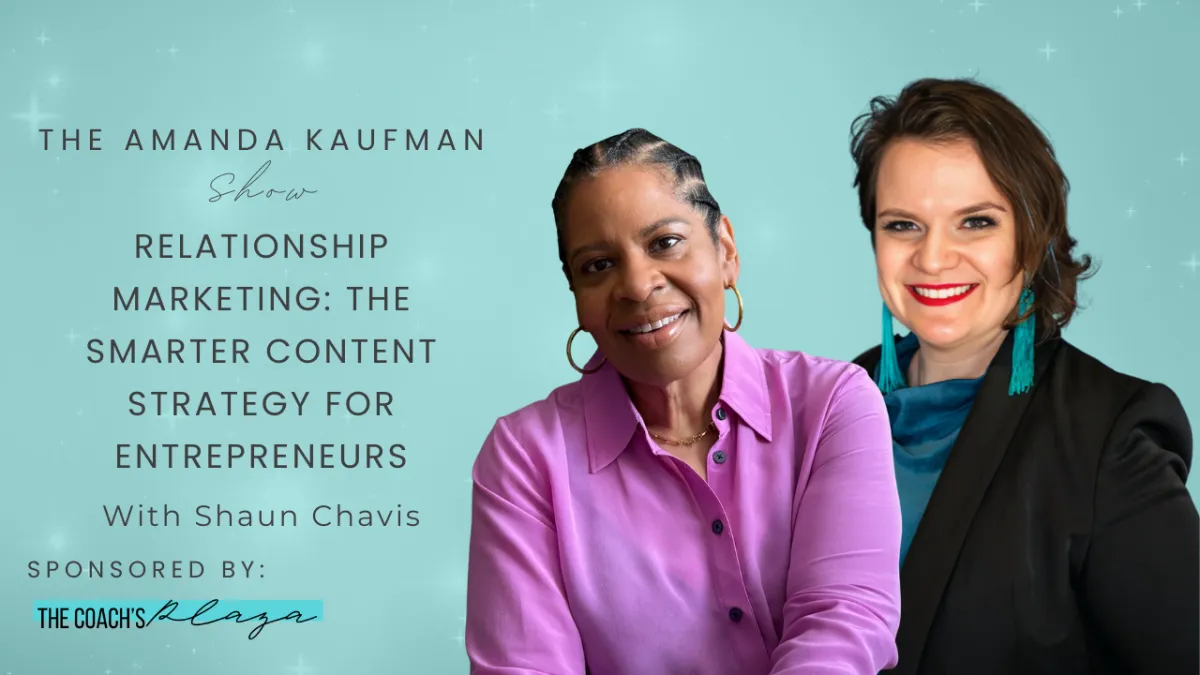
Relationship Marketing: The Smarter Content Strategy for Entrepreneurs
Relationship Marketing: The Smarter Content Strategy for Entrepreneurs
If you feel like you are constantly chasing the algorithm, you are not alone.
Entrepreneurs are told to post more, show up daily, repurpose everything, and stay ahead of every new trend. The pressure to remain visible is relentless. And yet, for many business owners, the results do not match the effort.
The issue is not your work ethic. It is your strategy.
What if the real opportunity is not in reaching more people, but in building stronger relationships with the ones already paying attention?
That is the heart of relationship marketing.
The Shift From Broadcasting to Building
Most content strategies are built around exposure. You publish something and hope it reaches as many people as possible. The goal becomes impressions, clicks, and follower counts.
But exposure does not automatically create loyalty.
Relationship marketing shifts the focus from broadcasting to building. Instead of asking how many people saw this, you begin asking who engaged with this. Instead of optimizing for reach, you optimize for resonance.
This shift may seem subtle, but it fundamentally changes how you approach your content. When your focus is relationship-driven, you stop treating your audience as passive viewers and start treating them as participants.
That requires a different level of intention.
Engagement Is the Strategy
One of the most important reminders from this conversation was simple: posting is not enough.
You cannot publish content and walk away expecting growth to happen automatically. Content is not a billboard. It is a conversation.
If you show up, drop a post, and disappear, you are standing at the edge of the room hoping someone approaches you. That is not how relationships are built.
Relationships are built through engagement. Commenting on other people’s work. Responding thoughtfully to replies. Participating in conversations. Supporting peers publicly. Collaborating instead of competing.
For coaches, consultants, and solopreneurs, this matters deeply. Your business is built on trust. Trust is built through interaction. Interaction requires presence.
Engagement is not extra work layered on top of content creation. Engagement is the strategy.
The Power of Long-Term Thinking
Another critical theme was the importance of long-term commitment.
Entrepreneurs are constantly tempted by new platforms, new features, and new trends. The moment something gains attention, there is pressure to pivot. Before long, you are experimenting with five different tactics and gaining traction in none of them.
A simple filter can prevent this cycle: Can I do this 20 times?
Before launching a new content idea, before committing to a new channel, ask yourself whether you can realistically execute it at least twenty times. If the answer is no, it is likely an impulse, not a strategy.
Sustainable growth requires repetition. Repetition builds familiarity. Familiarity builds trust. Trust builds revenue.
If you abandon every initiative before it has time to mature, you will constantly be starting over.
Long-term thinking may feel slower in the beginning, but it compounds in ways short-term tactics never can.
Collaboration Over Competition
Relationship marketing also challenges the scarcity mindset that dominates many industries.
It is easy to believe that attention is limited and that other creators are competitors to guard against. But relationship-driven growth thrives in collaboration.
When you co-create content, host conversations together, or publicly support others in your space, you expand your network in a meaningful way. You demonstrate confidence rather than insecurity. You build goodwill that often returns multiplied.
Collaboration accelerates trust because it positions you within a community instead of in isolation. It signals that you are invested in the broader ecosystem, not just your own metrics.
Entrepreneurs who understand this build stronger brands over time because they are woven into networks of real relationships.
Building an Audience You Own
There is also a deeper strategic advantage to relationship marketing.
Algorithms change. Platforms shift priorities. Tactics that work today may disappear tomorrow.
Relationships endure.
When you focus on building direct connections with your audience, you reduce your dependency on external systems. You create an ecosystem rooted in trust rather than visibility hacks.
That ecosystem becomes resilient. It allows you to pivot strategically without losing your core community. It protects you from volatility.
Owning your audience does not simply mean having their email address. It means having earned their trust.
The Discipline Behind the Strategy
Relationship marketing is not flashy. It requires consistency. It requires patience. It requires showing up even when engagement feels slow.
It also requires maturity.
You must be willing to prioritize depth over instant validation. You must accept that sustainable growth is quieter at first. You must resist the urge to chase every spike of attention.
But when you commit to this approach, something shifts. You stop feeling like you are performing for an algorithm. You start feeling like you are building something real.
And that changes your energy.
Instead of asking how to go viral, you begin asking how to serve the people already in your ecosystem. Instead of obsessing over follower counts, you focus on strengthening existing connections.
Over time, those connections multiply.
Chapter List:
00:00 Introduction to Substack and Shaun Chavis
02:46 The Unique Appeal of Substack
05:41 Strategizing for Success on Substack
08:20 Common Mistakes and Engagement Strategies
11:06 Launching and Building on Substack
14:04 Connecting with Shaun Chavis
Full Transcript:
Shaun Chavis (00:00)
And if you just post something and think if I build it, they will come, it's not going to work. You really do have to engage with people. And that is more important this year.
Amanda Kaufman (00:27)
Well, hey, hey, welcome back. I am so excited about this episode because my friend, Sean Chavis has joined us. She is a content marketing professional who's fallen in love with Substack. And now she helps brands and individuals incorporate Substack into their content and brand strategies. Sean's been a health tech startup founder, an award winning cookbook editor and co-founder of a
food blogging conference. And I met her when I was out and about on the internet streets networking one day and we were both in the same business incubator. She told me about her genius in Substack and I could not send her a message fast enough to invite her here because I'm hearing so many entrepreneurs are talking about Substack. Sean, welcome to the show.
Shaun Chavis (01:19)
Thank you so much for having me. I'm excited to be here.
Amanda Kaufman (01:22)
I'm just completely stoked. my first question is you have clearly a lot of experience in business and in marketing. What was it about Substack that called to you?
Shaun Chavis (01:35)
So I started on Substack a little over a year ago, just as an individual looking for like, at first I was kind of like, you know, can I monetize this? And at the time I was working for a weight care company and I thought, you know, I'll like create this niche weight care industry thing. And it felt too much like work and I was like, no, I can't do this. And I was like, what else can I do? And I had really been exploring fashion.
I've lost 140 pounds and so now I'm totally rebuilding my wardrobe. Like there's nothing you can take with you from 140 pounds heavier to now. it all has to go. so it is. Thank you. Thank you. So, I was like, you know, maybe like, you know, I'll start Substack is kind of like my creative outlet for exploring my, you know, style. What is my style and building my wardrobe. And as I started.
Amanda Kaufman (02:08)
Blankets? Yeah, no, that's a lot. That's, congratulations.
Shaun Chavis (02:25)
using Substack. It was a creative outlet that I really fell in love with, but then I started building relationships with people. I moved to Baltimore last year. Let me tell you how different Substack is for building relationships.
Everybody that I've met so far, almost everybody that I've met so far in Baltimore outside of my family or family connection has been through Substack. I cannot say that about any, I am not kidding you. I cannot say that about any other social media platform. And I've been, I've tried so many other, like I've done Twitter and TikTok and all, you know, all of them. I'm, I'm in marketing, but you know, the relationships that you build on Substack really stand out to me. And also I love the level of engagement that you
Amanda Kaufman (02:49)
You're kidding, wow!
Shaun Chavis (03:08)
have to really, like I'm just so fascinated by.
how many, how much brilliance there is out there. Like I think it's hard to see that, you know, in today's society. But when you go on Substack, you can see like people specialize in so many different things and have so many wonderful takes on things. And like you could totally go down a rabbit hole and it not feel like an icky rabbit hole because people are so brilliant and they're sharing their brilliance on Substack. And I love it. So I was like, I need to do something with this. So that's what's led me to where I am today.
Amanda Kaufman (03:39)
I love it.
What do you think it is about Substack? I like, I love that you have such a background in marketing, so you really have a good ability to compare. What is it do you think about Substack that really pulls out people's brilliance like that versus other platforms?
Shaun Chavis (04:03)
Sure. Well, number one, like it started as a newsletter platform, a newsletter publishing platform. So already there was kind of like this mindset of, you know, I can engage with people in a deeper way. You know, I can, you know, give, I don't have to give like little Twitter McNuggets. Like I can give like, you know, some engaging, valuable content to people. But also there's kind of like this different vibe. Like, you know, when you go on LinkedIn, like everybody's trying to be the know it all guru, you know, and it, it kind of feels
like a little pretentious, maybe more than a little. But you know, in Substack, people are just really genuine and tend to be more authentic and transparent. I can't really say what it is. I do know that up to this point, Substack has not had any advertising. So I don't know if that has been, you know,
that has been like part of that factor of people feeling like really transparent. You know, it hasn't been very photo forward the way that Instagram is. think, you know, we've all kind of, kind of are familiar with that Instagram kind of portraying like a life that isn't.
realize it's mediated reality at best, know, like it's, you so I think that some of the pressure is off in terms of people feeling like they have to show up and be the perfect person, whether it's like, you know, I'm the smartest guru or I'm the most beautiful influencer or whatever, or I have a perfect life kind of thing. So it really is different. From another standpoint, Substack is different than other social media platforms because the algorithm is different.
Amanda Kaufman (05:22)
you
Shaun Chavis (05:31)
Substack makes its money off of subscriptions. So it rewards long-term relationships. That's what a subscription is, right? So the algorithm isn't about showing up every day or posting three, four, five times a day like you did on Twitter. It's about building long-term relationships and it rewards engagement over time.
So that makes
Amanda Kaufman (05:49)
Yeah.
Shaun Chavis (05:50)
it different. I see a lot of people come on Substack and they start and like they post one or two times or they're posting a couple of notes and they've been there for a week or two. And then they're like, what's happening? Nobody's engaging with me. Am I doing something wrong? Is this isn't working for me? Like it is. It's because the algorithm is different. It's not Twitter. It's rewards long-term engagement. So you really have to have a long-term strategy when you come to Substack. So just chill and enjoy.
Amanda Kaufman (06:08)
Mm.
Let's talk about strategy.
So seriously, I love how you're calling out all these differences. LinkedIn, I do see that kind of guru pretentious vibe that you're talking about. I would say it's like echoes of corporate just everywhere. Whether you're in corporate or not, it just has that corporate America stale sort of a...
a feel and I'm all over LinkedIn, obviously, but I'm just saying like it's a very different intent, you know? With Substack, the thing that has had me definitely market or curious about it has been the fact it's based in reading, you know? It's based in reading and to be able to do something that even a very modest subscription is worth paying for, it really does elevate
the quality of the writing that's required in order to play that particular game.
Shaun Chavis (07:13)
Absolutely, absolutely. ⁓
Amanda Kaufman (07:14)
Yeah. So talk to me about this strategy.
Like what, you know, what are maybe three to five things that someone might want to consider when forming up their sub-stock strategy?
Shaun Chavis (07:26)
Sure. So the really interesting thing about Substack, even though it started based in writing, they got a hundred million dollar investment, they raised a hundred million dollars last year at a $1.1 billion valuation. And so now Substack is aspiring to be a studio in your pocket. That's their words, not mine. And so now when you come on to Substack, you still have the newsletter. You can create a newsletter. That's like what everybody knows it for, that knows Substack. Then you have like a
presence or kind of like a website that's basically your home for the newsletter. But then you can do so much more. You can host a podcast on Substack. You can do live events on Substack. can, you know, you can do a video or audio podcast. You can push those out to YouTube or other platforms. So, you know, you can do that. You can take live events. You can chop both the podcast and the live events up into YouTube shorts or other short form videos to use on other platforms.
platforms, you have a with your Substack newsletter, you have a private chat that you can pay wall or not pay wall, but it's just for you and your subscribers. So you have that kind of community building aspect to it. So there's a lot that you can then, you know, now there's, you know, there's video in the like, Substack has its own social media platform called notes, and it's kind of like threads. Some people liken it to Twitter, but to me, it's like
not Twitter, it's a little more engaging to me, it's more like threads. But so it has like its own internal social media. So it has that going for it. And then you can put video, you can put a photo carousel in it, you know. So, and then you can like do, you can audio record your newsletter. So you have that way to engage. There's so many different ways you can engage on and create content on Substack. So you don't have to feel like.
you know, I have to be a good writer to be on Substack. You don't. And if you really gravitate toward, you know, talking on camera, do that. You can do that on Substack now. If you really gravitate toward, you know, photography, you know, or that's the way that you tell your story, do it. You can do it on Substack. So what I recommend, a lot of people come to Substack and they think, my gosh, I got to be all these things. And I, you know, I got to juggle it all. No, you don't. Or they feel like I have to be a good writer and I'm not a good writer.
you don't. So what I recommend is number one just pick one thing and pick the thing that you know you can stick with.
Right? So again, have a long-term strategy because that's what the algorithm rewards. Have a long-term strategy. Pick the one thing that you really love that you know you can stick with and pressure test it if you need to. Like a lot of times when I'm starting an idea, I like, sit down and I say, okay, can I do this 20 times? Like, you know, write out 20 ideas to see if it flies, you know, to see if it has legs to it. so if you need to do that, do that. But just like my number one recommendation is pick the one platform.
Amanda Kaufman (09:45)
Mm.
Shaun Chavis (10:13)
within Substack that you know you love and that you can stick with long-term. And that's like my biggest piece of advice.
Amanda Kaufman (10:20)
That's so good. That's so good. And dear listener, fourth wall break. I mean, I've been consistent with a podcast for about five years, wickedly consistent in the last two years. And, you know, one thing that I found really makes my content strategy sing is build the content and then put it on the different platforms. So like I'm writing down my
Substack question mark like is this another channel we want to bring on board because we already do video We already do articles. We already do all these things Sean. You're inspiring me like this is amazing So, okay. Here's what to do Why would you say not to do like what what doesn't work on sub stack or what what what is what do you see as? Maybe some of the more common mistakes that people are making, you know, if their intent is to have a strong
Shaun Chavis (10:43)
Uh-huh.
Amanda Kaufman (11:08)
content strategy on sub stack. Say that five times fast. ⁓
Shaun Chavis (11:11)
Absolutely. I know, right?
The number one mistake that I see brands and individuals make, and I see this a lot with brands, like they just, you I don't know if they're stretched thin or they just want to try it and see what happens, but to not engage. Like if you just post something and walk away, like, Substack is not like a one-sided conversation at all.
And if you just post something and think if I build it, they will come, it's not going to work. You really do have to engage with people. And that is more important this year.
And I would say that's more important this year across all kinds of social media platforms, but particularly Substack. You have to be in notes. You don't have to be in notes every day. You don't have to post a note every day, but get in there and start engaging with people. Comment on their notes. Comment on their newsletter posts.
into some chats and you know start getting to know people like don't be the person that goes to the party and stands against the wall right like you have to start mingling and that's how you get engagement and then like so if you're going to be strategic about it like say like you're a coach or you're a solopreneur and you're trying to build your audience and find your fan base and start building customer relationships start
like partnering with people on Substack. One of the other beautiful things about Substack is, yeah, everybody's, you know, like you have competitors or people in your competitor space, but it's really collaborative too. People tend to support each other. I write a fashion Substack and I found a lot of support from other fashion and style writers. People are willing to do lives with you. People are willing to collaborate on content with you. I just did a series with someone. We did like a five part
like thrift shopping series, you know, and it was successful for both of us. So find people to collaborate with on content and it's just so easy to do on Substack. And so I think that's another way to win strategically as a solopreneur, as a coach. It helps you elevate you, it helps you build relationships, it helps you build your audience and it's just a great place to do it.
Amanda Kaufman (13:15)
I'm gonna start asking my guests for their Substack link, you know, because I do really see it gathering a bunch of steam. so where are you headed, you know, when it comes to being a content marketing strategist for Substack? Like, what does that actually mean? When would be a good time for somebody to come and talk to someone like you?
Shaun Chavis (13:38)
Yeah, so
I really focus on helping people launch. Like that's where I feel like, like that's where people are in the life cycle of Substack. Like a lot of people are going, Substack. How do I do this? What is Substack? So I'm kind of there, especially if you have specific goals. So I've, I've worked with companies who have, you know, looked at the marketing landscape and, you know, seeing what's, AI is doing in marketing and realize like, Hey, we have a brand book, but we haven't actually built relationships.
relationships with the brand book. You know, how can we do this? know, SEO is not working like it used to. Search isn't working like it used to. We need to build customer relationships. We want people to be able to distinguish our brand from the competitors. Maybe Substack's a good place to do that. That's where I can come in. I can help you find like where, you know, what is the competitive landscape for your
industry on Substack, where is your white space and what can you own and how can we take your brand book and make that come to life on Substack? Like what does that look like on Substack when you're engaging with people and building whatever content strategy you're going to build with Substack. So that's a great time to bring me in. I can help you with that. And then there are people, just individuals who are just like, how do I start on Substack? When you first come on Substack, I admit like you go to that dashboard for the first time, there is so much,
can set up. Like it's really overwhelming and you're kind of like, ooh, okay. So with individuals, I help you figure out like, what are the first few things that you can set up that immediately signal this is your brand, this is who you are, this is what kind of experience people are going to have with you if they engage with you on Substack. So those are like the two main things that I help individuals and brands with.
Amanda Kaufman (15:22)
So good, so good. Sean, what is the best way for people to find out more about you and catch up with you?
Shaun Chavis (15:29)
Yeah, so just reach out to me on my Substack is the best way. It's redressing.substack.com. It is my fashion Substack, but if you message me there, I will get back to you and we can talk about helping you make your landing on Substack and improve your strategy on Substack.
Amanda Kaufman (15:48)
So good. Thank you so much for being here today.
Shaun Chavis (15:51)
You're welcome. Thank you for having me. This was fun.
Amanda Kaufman (15:54)
Of course, and dear listener, we've got all of Sean's links, all of her socials, not just the Substack in the show notes below. So do be sure to check that out. And you know what? I'm sure you've got some entrepreneurial friends who are looking to stand out in the marketplace. And what better way to do it than on a rising channel like Substack. So grab this episode.
Flip it over to them, just send it to them on text or over the DMs, however you guys like to hang out and chat, and share it with three of your friends that might be really interested in being successful on Substack.
And we're gonna be back for the next episode. You don't wanna miss it. So make sure you hit subscribe if you haven't already. And finally, if you've been loving the show, do take the 30 seconds to leave us an honest review because it helps new listeners decide whether they wanna hang out and spend time with us. And we're always so in... We're gonna be back again real soon. And until then, just make sure you do what matters.