Why Most Business Owners Never Finish the Book They Start
Why Most Business Owners Never Finish the Book They Start
Most business owners don’t abandon a book because they lack discipline, talent, or time. They abandon it because they start writing before they have clarity.
At the beginning, there is excitement. An idea feels important. The book feels obvious. Maybe it even feels overdue. But excitement is not the same thing as direction, and momentum built on excitement alone rarely survives the middle of a project. That is where most books quietly die.
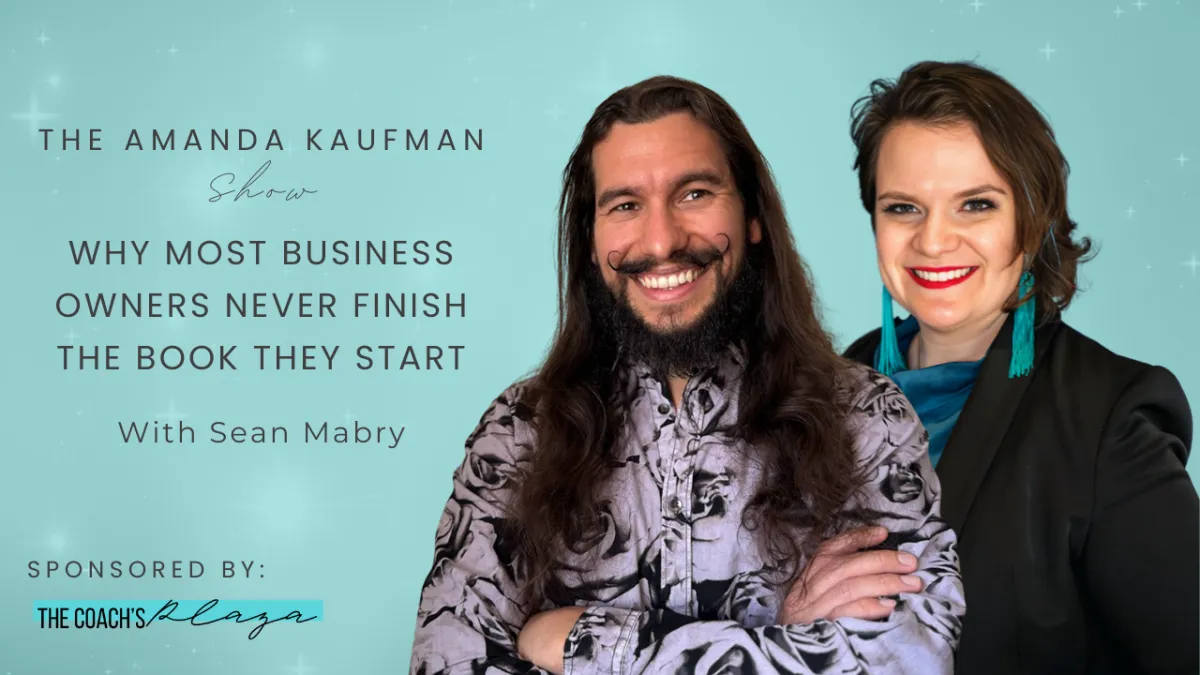
In this episode of The Amanda Kaufman Show, I sat down with Sean Mabry, a ghostwriter who works with business owners who know they should write a book but cannot get themselves across the finish line. What became clear very quickly is that the problem is not effort. The problem is starting without a map.
Excitement Is Not the Same as Clarity
Most people underestimate how foggy their idea actually is. In their head, the book feels clear because the idea is emotionally charged. But the moment they sit down to outline it, the cracks appear. Chapters blur together. The audience is vague. The promise of the book is hard to articulate in a single sentence.
This is usually the moment when resistance shows up. Writing suddenly feels heavy. Progress slows. The book becomes something that will be returned to “when there’s more time.” That time rarely comes.
The issue is not that the idea was bad. It is that the idea was never fully formed.
Clarity is not something that magically appears once you start writing. It is something you earn by asking the right questions before you write a single page.
Why Starting Without a Plan Backfires
There is a persistent belief among business owners that structure will kill creativity. That outlining will make the work feel rigid or mechanical. In reality, the opposite is true.
A clear plan removes unnecessary friction. It prevents wasted effort. It creates confidence instead of doubt.
Sean shared that one of the first things he does with clients is create a formal book proposal, the same type of document used when approaching traditional publishers. Not because every client wants a traditional deal, but because the proposal forces honesty.
A proposal answers questions most people avoid:
Who is this book actually for?
Why does it need to exist?
What problem does it solve?
Why is this the right book for this author to write?
Without clear answers, writing becomes guesswork. With them, writing becomes execution.
The Middle Is Where Most Books Fail
Most unfinished books make it past the beginning. The opening chapters often exist. The idea gets started. What stops people is the middle.
The middle requires sustained belief. It requires knowing where the book is going and trusting that it is worth finishing. When that belief is not anchored in clarity, doubt takes over.
Business owners are especially vulnerable to this because time is already scarce. Writing a book competes with revenue, leadership responsibilities, and personal life. When the book does not feel clearly valuable, it is the first thing to be deprioritized.
Clarity changes that dynamic. When the book has a clear purpose, it becomes harder not to finish. It feels less like an obligation and more like something that wants to be written.
Planning Is Not a Constraint. It Is Protection.
There is a reason experienced creators emphasize planning. It protects you from false starts. It protects you from chasing ideas that do not deserve years of your attention. It protects you from confusing enthusiasm with readiness.
One of the most grounded insights from this conversation is that not every idea should become a book. Some ideas are not ready. Some are meant to stay as talks, articles, or frameworks. And some ideas, once clarified, reveal themselves as powerful books that deserve full commitment.
Clarity gives you permission to say no to the wrong book so you can say yes to the right one.
Why Business Owners Delay Writing
Many people avoid planning because they fear disappointment. If they make a plan and it does not work, the failure feels personal. So they stay vague. They keep the idea loose. They avoid committing.
But vague ideas are far more likely to fail than clear ones.
A clear plan does not guarantee success, but it dramatically improves the odds of finishing. More importantly, it builds confidence. When you know why the book exists and who it is for, writing stops being an emotional guessing game.
The Question That Changes Everything
Before writing a book, there is a simple but uncomfortable question to answer: does this book deserve to exist?
Not every idea does. And that is not a failure. It is discernment.
The goal is not to write a book for the sake of writing a book. The goal is to write the right book, for the right audience, at the right time, with the right level of commitment.
When that alignment is present, momentum follows.
Finish What Matters
Most business owners do not need more discipline. They need more clarity. They need to stop treating writing as a test of willpower and start treating it as a strategic decision.
If a book is going to demand years of your attention, it should be chosen deliberately. It should be clear enough to guide you when motivation fades. And it should matter enough to survive the middle.
That is why most books never get finished. And that is also why the ones that do start with clarity, not excitement.

Chapter List:
00:00 The Importance of Storytelling in Business
02:52 Crafting a Book Proposal: The Roadmap to Success
05:32 Overcoming Fear and Resistance in Writing
08:13 Introducing the Book Clarity Tool
11:04 Connecting with Sean Mabry and Final Thoughts
Full Transcript:
Sean Mabry (00:00)
Because after that initial burst of enthusiasm wears off, and also you might think you have a clear vision in your head, you will see how foggy it actually is until you try to outline.
That's part of the benefit of outlining is that it forces you to be thorough and ask the right questions.
Amanda Kaufman (00:11)
It's true.
All right, well, we had some Hollywood magic happening around here, some technical fun. And between like the full technical meltdown of my machine and now I pulled a card from my friend Janik Silver's deck and it says, you cannot pour from an empty cup. And I thought, wow, how perfect is it that I'm talking to Sean and he has this beautiful service where he ghost writes for business owners.
Sean Mabry (00:35)
Ha ha ha!
Amanda Kaufman (01:01)
who so, so often end up pouring from an empty cup. know, like they just, they try to go, go, go, go, go. And if they don't get their footing with this expert positioning with their message and just like writing down the stories that matter, that's just one of those things that tends to get kicked down the road. So can you talk to me a little bit about...
what it's like to hire a ghost writer versus, you know, the standard thing that a lot of business owners do is, I'll do it myself. I'll just make more hours in the day and I'll just do it. Like, obviously you're very talented at storytelling and writing, but you know, like if somebody's thinking about going this direction, what might make it a good idea?
Sean Mabry (01:41)
Yeah, mean, I often by the time someone comes to me, they have tried to do it themselves. They've probably even worked with other ghost writers that couldn't get them over the finish line. And I think that really comes down to identifying the heart of your story, which is kind of what I've been talking about this whole time in different forms. But this is part of why that's so important. And it's part of why actually one of the first things I do to give you a little bit of the process is
I have us write and agree on a book proposal, which is exactly what you would need if you were to go to a traditional publisher, which really you would technically you would submit that to a literary agent who decides if they want to represent you and then they go to publishers. But ultimately the whole idea of it is to justify why should the book exist? And there's a specific structure to it. The main thing is the outline, but there's even some more stuff beyond that.
And the reason why, nobody in, like, even though I do work with an agency that handles the publishing stuff, it wasn't their idea to start doing that. That was all me. Because I was like, I love this document because it keeps us honest. It forces us to ask the right questions about who this book is really for, what kind of book it is. And when you get really clear on those things, that alone creates such a surge of momentum that it becomes harder to not finish the book than to finish it.
And it shocks me how many other people don't do that. Like even other ghost writers don't really do that step or they do kind of like a halfway rusty version of it where I'm like, no, I'm very methodical about that step. Because if we don't do that step, we will pay for it later. Ask me how I know. ⁓
Amanda Kaufman (03:24)
million percent. mean, like so
much is coming up. I'm like, wow, you know, you tend to finish how you start, right? So like if you start as a hot mess, then guess where you're headed. Right. But like I literally lit up when you said that because you're the first person that I've talked to about this that like talks so enthusiastically about the proposal stage. Right. And, you know, one of my mentors always says the best time to have a map is before you go into the woods.
Sean Mabry (03:33)
Yeah.
Mm-hmm.
Yes.
Amanda Kaufman (03:52)
And it just strikes me that that
is your map. That's like for a business, having a business plan or even if you're very, shall we say creative and you're like, now I don't want to be bound by the convention. I get it, totally. And I've just noticed again and again, when I'm doing a campaign or a new program or something like that, I call it the master plan.
And it is basically, like you said, it's the justification for all of the work that's about to occur.
Sean Mabry (04:19)
Yeah, totally. And you will get this. So I don't bring this up in front of just anyone, but I think you'll vibe with this a lot, is that I know I'm on the right track where even just working on that proposal, there's like this spooky energy that starts happening where it's like, feel like I'm, it's almost like there's like a living entity on the other side of it that I can feel talking to me through the document. And it's like,
To me, that's like the spirit of the book. It's like starting to come through. And again, it's like, why would you skip that step? Like, it's madness to me that anyone would. Especially because if you can't get that like spooky feeling there on the proposal, you're not gonna get it in the book. I promise you. Right? So that's like the first acid test. And you know, and like I'm pretty good at finding it, like even in that stage. So, and you know, in that point, it's just, I've...
Amanda Kaufman (04:59)
so true.
Sean Mabry (05:10)
I've never gone through that step and then had any kind of doubt going through the project like, do we really have a book here? It's like, no, I know we do. I've already met the book. Now we're just getting it written. Yeah.
Amanda Kaufman (05:18)
Well, because we predetermined that.
Yeah.
You're making me think about like Stephen Covey. He was one of the first people that I read in personal growth and development. He has this idea about when you create something, it's created, I think he says three times. So, you know, by the way, dear listener, come at me if I've got that wrong. It has been a long time since I read those books. But the concept, right? It's like first you have the inception of the idea and you actually create it in your mind. You create this vision. Then you can create the plan and then you create the physical, the physical
Sean Mabry (05:35)
Mmm.
Amanda Kaufman (05:49)
thing and if you just realize like everything gets created three times you don't have to you don't have to fear that step of like what's your plan right and you know speaking as a coach I think the answer to your question was like you know it's madness why would know why would people not write down the plan there's more and more I'm convinced that people don't plan because they don't want to be disappointed when the plan doesn't work out
Sean Mabry (05:57)
Right? Right.
Hahaha!
Ah, that's a big, which actually that's another huge piece of this I think is worth addressing is it is like even now, like I said, I'm working on my own book and I will say I am applying every single tool I use on my clients to myself with exactly as much, I wrote my own book proposal, right? I even, as we'll get to in a second, there's like a little tool we'll talk about in a second. I use that on myself to figure out if I, what book I should even write.
And it's, I mean, it's eye-opening to me even, you know, eating, taking my own medicine because it's like, wow, this is really clarifying. And it's also smashing through the fear and resistance I had for years. Cause this is not the first time anyone's ever asked me like, Sean, when are you going to write a book? Right. I've had people asking me that for years. And, uh, at every point it was like, well, I don't know to write about. All the usual stuff. Right. But even beyond that, it was like,
If we go even further back, when I was an attempted novelist, I did go through and just start writing. And that's part of how I learned, don't do that. Because after that initial burst of enthusiasm wears off, and also you might think you have a clear vision in your head, you will see how foggy it actually is until you try to outline.
That's part of the benefit of outlining is that it forces you to be thorough and ask the right questions.
Amanda Kaufman (07:34)
It's true.
Sean Mabry (07:37)
And then, then you actually will have clarity once you answer those questions. But until you do that, until it's like, and it's just a glimmer in your eye, good luck. There's all kinds of ways that that can go awry. I'd rather know in advance what those are. And I think you're so right.
Amanda Kaufman (07:54)
Well, and I think I love that,
writing the proposal is like a, it's a lower, lower stakes project, right? I can't recall exactly how many words are in a book. But like, if you're sitting down to 50,000, 75,000 words versus a book proposal, you know, and I understand you might, you might have a little, a little something that you want to share with the audience today that kind of gets them on the path of thinking like this. You want to tell us about that?
Sean Mabry (08:01)
Yes.
Yeah, so this is a tool I created called the Book Clarity Engine. And what it is is it's a custom GPT that I built with a very specific set of rules on the back end that are designed to guide you through a 30 to 60 minute session that answers, should I write a book and what kind of book? And you'll either get a green light, yes, go ahead, right now, yellow light, yes, with some important modifications, or red light, don't do it.
Don't waste your time. And this thing, I mean, everyone I've run through the thing so far, myself included, all agreed that it's amazing. Just using this tool is so eye-opening and also it is brutal. It is going to kick your butt and make sure that you're actually telling the real story. And that's the thing is like what inspired that was as I kept having conversations with prospects, I realized so many of them are either
Either they've kind of started on the wrong book and I'm having to kind of catch them and yank them over midstream. You're yeah, you really should be doing this over here. or the fear they have of even getting started is completely legitimate because their fear is I'm going to start writing and get lost somewhere in the middle. And then it's just a bunch of wasted time and energy, which if you're a successful business owner are not things you have in spades. So, I completely get that. And in fact,
That's why I created this tool to give you that clear answer. And again, this is what I keep saying when people have gone through it is not only is it the clarity of like, yes, go ahead and write this, this is a viable book. It should be so exciting that you can't help but to want to take the next step. That's really what this tool is designed for is that this thing is screaming at you like, write me, write me now. I deserve to exist, let's do it, right? If you don't get to that point, then don't start a book. Why would you ever?
Right? Like, the world doesn't need... Yeah! It is! Even with a ghostwriter, right? Like, because we're still gonna have to... I I do a lot less interview time than other ghostwriters do, but still, like, it is gonna take effort, you are gonna have to go through revisions with me, just like, you little fact checking, things like that, but ultimately, like, I want to make sure the time is well spent. For you. Right? For both of us. And that's where this tool comes in.
Amanda Kaufman (10:11)
Right, that's a lot of work. Goodness.
⁓ Absolutely.
Yeah, no, that's incredible. Sean, like if people wanted to follow you, what's the best way to do that?
Sean Mabry (10:44)
The easiest way is just to connect with me on Facebook. I post there all the time. I'm super active. I do answer my DMs. And it is actually me, not a VA. So yeah, easiest way to contact me is right there.
Amanda Kaufman (10:53)
Amazing, amazing. And if they connect with you, is there like a keyword or something that you'd like them to use so that you can send them this GPT?
Sean Mabry (11:02)
Amanda, just say Amanda and I'll know.
Amanda Kaufman (11:05)
All right, very good. Well, Sean, thank you so much for being on the show.
Sean Mabry (11:10)
Awesome, thank you, this has been so much fun.
Amanda Kaufman (11:13)
Appreciate you and dear listener don't forget if you haven't hit that subscribe button make sure you do it so you don't miss another episode and we've got all of the links and all the ways you can follow Sean in the show notes below and by the way if you love this and you have a friend who has been maybe they're the friend that you're like hey friend you should write a book maybe they should listen to this episode first so go ahead and grab the link and share it with at least three of your friends so that they can benefit from it and then finally if you're
Sean Mabry (11:37)
Yes, please.
Amanda Kaufman (11:42)
just loving what we're doing here at the show. One of the best things you can do for us is leave us an honest review. So when you leave that review, it helps people to decide, do I want to spend my precious commute or my precious morning walk listening to this show? That review, it's two minutes for you and it is so tremendously valuable for us. So thank you so much for everyone who has left us a review. We're going to be back with another episode very shortly, but until then, make sure you do what matters.